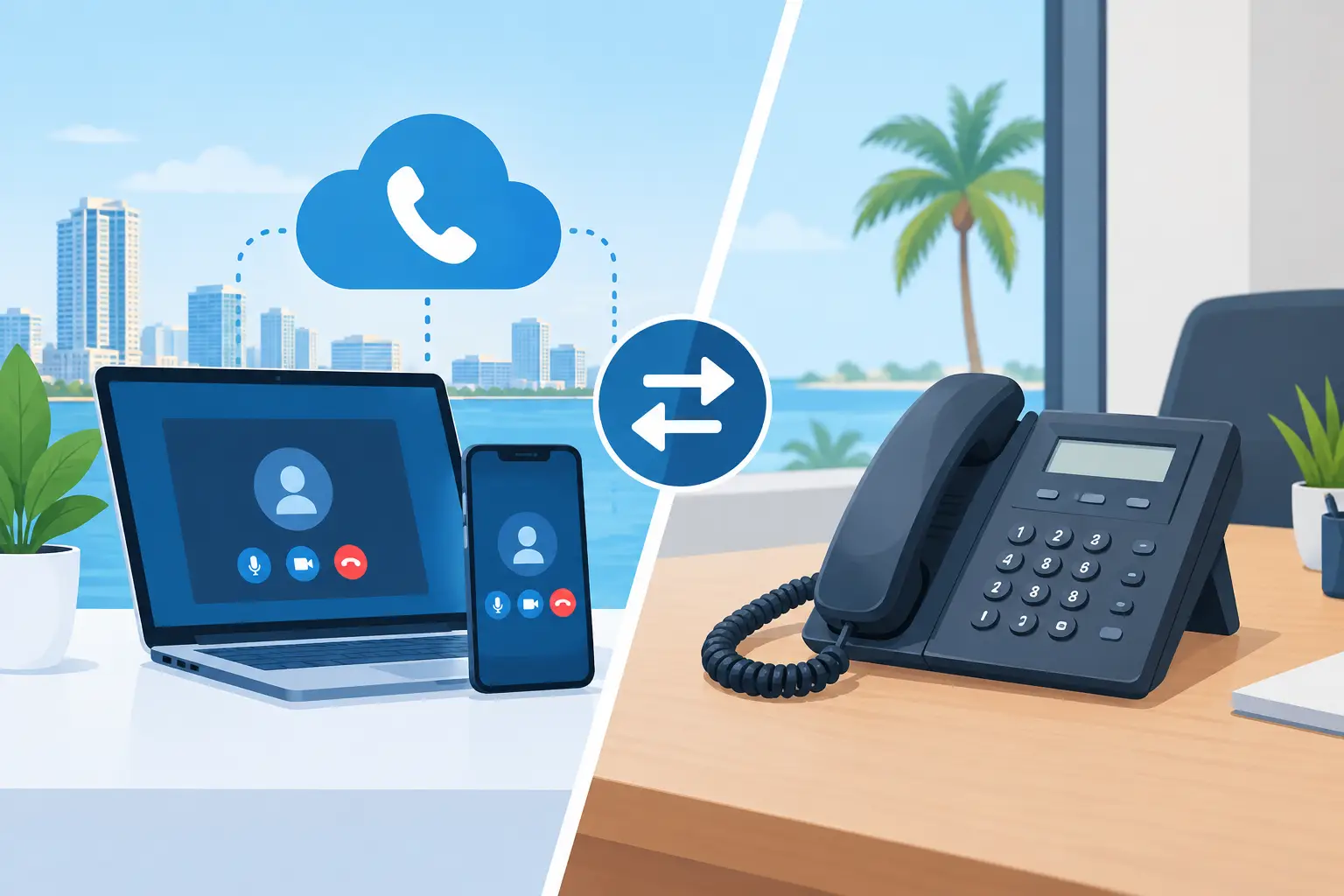
When a customer needs help, a missed call can become a missed opportunity. That makes the choice between VoIP vs traditional phones more than a technology decision. For Southwest Florida businesses, it affects how reliably employees answer calls, how quickly teams recover after an outage, and how predictable monthly communication costs remain.
Traditional phone service still has a place in certain situations, particularly where legacy equipment or a true copper phone line is involved. But for many small and midsize businesses in Bonita Springs, Naples, Fort Myers, and surrounding communities, a professionally managed VoIP system provides more flexibility without sacrificing the reliability they expect.
VoIP vs traditional phones: the practical difference
Traditional business phones usually connect through physical telephone lines supplied by a carrier. Depending on the service, those may be older copper lines, digital business lines, or carrier-provided connections that look traditional to the user but rely on newer infrastructure behind the scenes. Each desk phone is tied closely to a location and a phone line configuration.
VoIP, short for Voice over Internet Protocol, sends voice calls over an internet connection. Employees can still use familiar desk phones, but they may also make and receive business calls through a computer or mobile app. The phone number, voicemail, call routing, and settings are managed through a cloud-based phone platform rather than a separate phone line at every desk.
The difference matters most when work does not happen from one fixed desk. A construction project manager taking calls from a job site, a real estate team working between offices, or an office administrator working from home can continue using the same business number with VoIP. With traditional service, extending that same experience often requires forwarding calls, adding lines, or relying on personal cell phones.
Cost control is more than the monthly phone bill
Traditional phones can appear straightforward because the bill is tied to a known number of lines. The costs become less predictable when the business needs changes. Adding a line, moving a phone, supporting a new location, changing a call tree, or expanding long-distance calling may involve carrier requests, installation visits, and separate charges.
VoIP generally makes growth easier to manage. A new employee can often receive an extension, voicemail, and calling access without waiting for a new physical line. Features that may be separate add-ons with traditional service - such as an automated attendant, call queues, voicemail-to-email, mobile access, and call forwarding - are commonly part of a business VoIP package.
That does not mean VoIP is automatically less expensive for every organization. A small office with one rarely used line and no need for mobility may not see a meaningful financial advantage. Businesses should compare the full cost of ownership: carrier fees, feature charges, equipment, moves and changes, support time, and the cost of missed or misrouted calls. A flat-rate managed technology approach can help turn those variables into a more predictable monthly expense.
Reliability depends on preparation, not just the phone type
The strongest argument for traditional phones has long been power-outage reliability. A true analog copper line can carry its own power, allowing a corded phone to work when building power is out. That can be valuable during a storm or local electrical disruption.
There is an important catch: not every line that looks traditional has that advantage. Many modern carrier services depend on fiber, cable equipment, digital gateways, or on-site power. If that equipment loses power, the phone line may go down unless it has battery backup. Businesses should confirm what they actually have rather than assuming a traditional line will operate during an outage.
VoIP needs power for phones, network equipment, and internet service. That makes planning essential in Southwest Florida, where storm season and utility interruptions are real operational risks. A dependable VoIP setup should include battery backup for essential network equipment, a properly sized internet connection, and a documented plan for internet loss or building evacuation.
Call continuity can also be a strength of VoIP. Calls can be automatically redirected to mobile devices, a secondary office, or an answering service if the primary location is unavailable. With an internet failover connection or cellular backup, some businesses can keep operating even when their primary provider has an interruption. The right design depends on how costly it would be for your organization to miss calls for an hour, a day, or longer.
Security and compliance need attention
Business calls can contain customer details, payment discussions, scheduling information, and sensitive internal conversations. Traditional systems are not free from risk, but their smaller feature set can reduce the number of settings to manage. VoIP adds useful capabilities, along with security responsibilities.
A properly managed VoIP environment should use secure account access, strong passwords, multi-factor authentication where available, controlled administrator permissions, and regular review of call routing rules. It should also be monitored for unusual activity, including fraudulent international calling or unexpected configuration changes. These protections matter because a compromised phone account can create direct costs and disrupt customer service.
For healthcare-adjacent offices, financial businesses, and professional-service firms, the phone system should fit into the wider security plan. That includes knowing where voicemail messages are delivered, who can access call logs, and whether mobile devices used for business calling are secured. The phone platform is one part of the business network, not a separate item to set up once and forget.
Where VoIP is usually the better fit
VoIP is often the practical choice for organizations that need flexibility and want phone operations managed as part of their broader IT environment. It is especially useful when employees work across multiple locations, answer calls from mobile devices, or need a professional response even when the office is closed.
A VoIP system can help a growing business present a consistent experience. Callers can reach the right department through an automated menu, calls can queue during busy periods, and employees can transfer conversations without asking customers to call another number. Managers can update schedules, holiday routing, and on-call coverage without waiting for a carrier technician.
It also simplifies transitions. When an office moves, staff can often take desk phones to the new location or sign in through an app while the move is underway. If a hurricane or facility issue forces temporary remote work, the main business number can remain available rather than sending customers to personal cell phones.
When traditional service may still make sense
Traditional service can be appropriate for a limited number of uses. An analog line may be retained for certain alarm panels, elevator phones, fax equipment, or emergency backup, provided the equipment and local requirements support it. Some businesses also keep a basic backup line where continuous voice service is critical and the primary internet connection lacks reliable failover.
The decision should not be based on habit alone. Older phone systems may become harder and more expensive to support as carriers retire legacy services. Before investing in repairs or adding lines, consider whether the system can support your staffing plans, locations, and continuity requirements over the next several years.
Questions to answer before choosing a phone system
A productive phone-system discussion starts with the business, not the hardware. Consider these five questions:
- How many calls do you receive, and what happens when no one answers?
- Do employees need to work from home, job sites, or more than one office?
- How long can your business operate without internet, power, or access to its primary location?
- Which systems need phone connectivity, including alarms, elevators, faxing, or door entry?
- Who will make updates, support users, and respond when calls stop working?
The last question is often overlooked. A phone system can have the right features and still create problems if there is no accountable support team when a call queue fails, a number needs to be ported, or an employee cannot receive calls. Local coordination matters when phone issues overlap with internet service, network equipment, Microsoft 365, mobile devices, or cybersecurity concerns.
Prisca Nova helps Southwest Florida businesses evaluate and manage VoIP business phone systems alongside the networks and security controls they rely on every day. With local support, flat-rate technology planning, and a one-hour response commitment, the focus stays on keeping communications available instead of leaving your staff to manage multiple vendors.
The right phone decision should make it easier for customers to reach a real person and easier for your team to keep working when conditions change. Start with your continuity needs, not a feature list, and build the system around how your business actually operates.