A Naples office loses access to Microsoft 365 at 8:15 a.m. A Fort Myers construction team cannot reach its files from the field. A Bonita Springs firm receives a suspicious invoice email that looks like it came from a vendor. In each situation, the business does not need a vague promise of support. It needs a qualified person to respond, contain the issue, and keep work moving. That is the real question behind managed IT versus internal staff: which approach gives your business dependable coverage when technology is under pressure?
For small and midsize businesses, the answer is rarely about whether an internal employee is valuable. It is about whether one person, or even a small team, can realistically provide the range of support, cybersecurity oversight, strategic planning, and availability the organization needs.
Managed IT Versus Internal Staff: What Actually Changes?
An internal IT employee works directly for your company and may know its people, applications, and routines exceptionally well. For a business with complex operations, specialized industry software, or a large technology footprint, that familiarity can be a major advantage. An internal team can also be physically present to support frequent on-site needs, such as workstation deployments, equipment moves, and employee training.
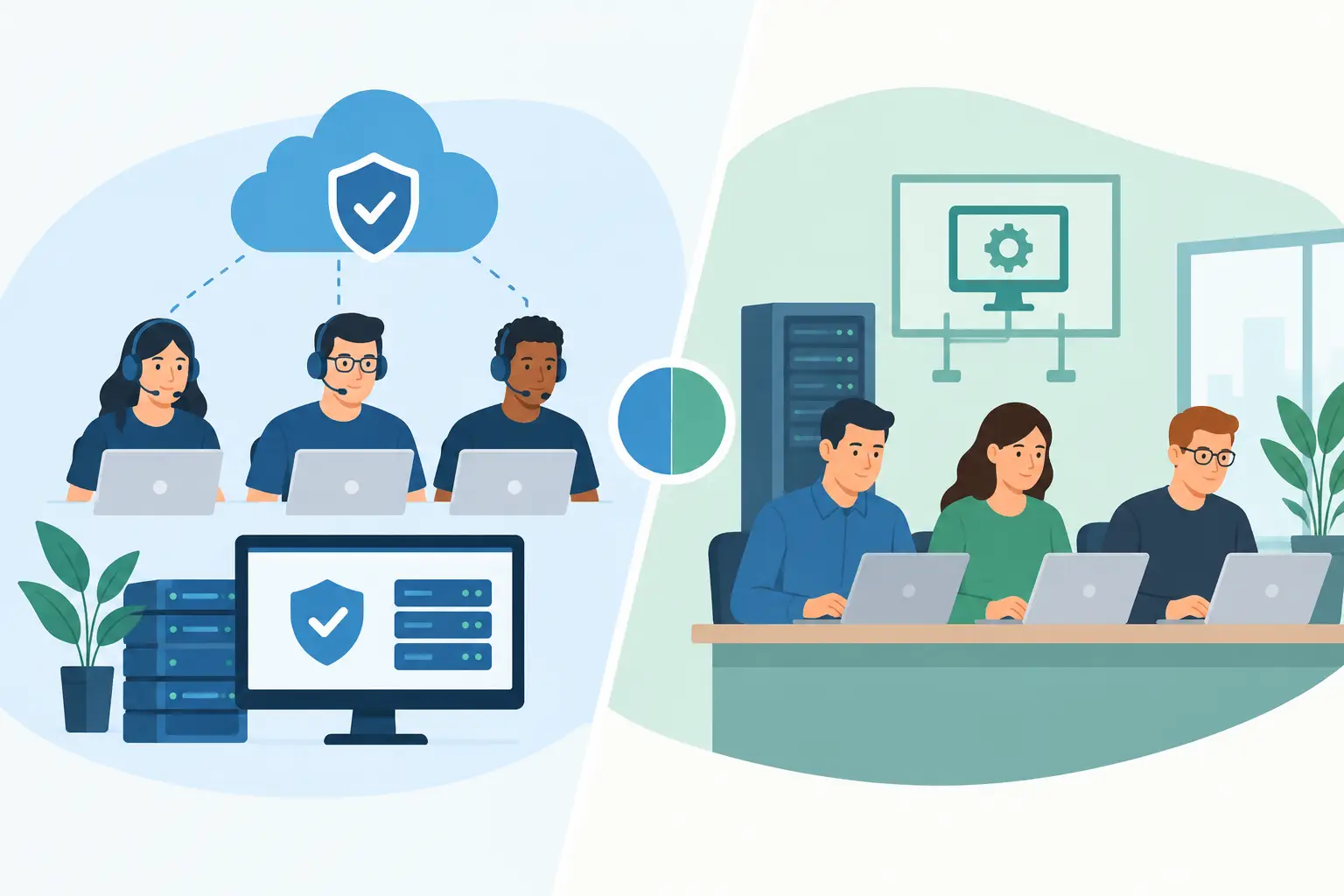
Managed IT services take a different approach. Instead of hiring technology staff individually, your business engages a provider to manage agreed-upon technology responsibilities for a predictable monthly fee. That commonly includes monitoring, help desk support, cybersecurity management, Microsoft 365 administration, device maintenance, cloud services, backup oversight, and coordination with internet, phone, and software vendors.
The distinction is not simply employee versus outside company. It is individual capacity versus access to a broader support structure. A managed provider can bring multiple skill sets to the relationship, while an internal employee brings day-to-day familiarity and direct ownership. The right model depends on your operating needs, risk level, and budget.
The Cost Is More Than Salary
Salary is the most visible expense of internal IT, but it is not the full cost. Hiring also involves payroll taxes, benefits, recruiting time, training, certifications, management time, and the cost of coverage when that employee is sick, on vacation, or leaves the company. If your business needs expertise in cybersecurity, cloud administration, networking, VoIP, and Microsoft 365, one hire may not have deep experience in every area.
A managed IT agreement is usually easier to budget. Flat-rate pricing gives business leaders a clear monthly technology cost instead of a series of unpredictable repair bills, emergency consultant charges, and unplanned project expenses. That predictability matters when a technology failure can delay billing, disrupt client service, or stop employees from working.
Managed services are not always the lowest-cost option on paper. A company with a sizable internal IT department may still need specialized outside support for compliance, security testing, cloud migrations, or after-hours monitoring. Conversely, a small office with only basic needs may not require a full managed service package. The comparison should focus on total coverage, not the hourly rate or salary line alone.
Coverage Is Often the Deciding Factor
Technology problems do not schedule themselves around business hours or one employee's availability. A single internal administrator can be highly capable, but that person cannot simultaneously answer user requests, investigate security alerts, manage backups, negotiate with vendors, plan upgrades, and monitor systems around the clock.
This creates a common problem for growing businesses: the internal IT person spends most of the week responding to immediate issues. Strategic work gets postponed. Security improvements wait. Old computers remain in service longer than they should. Documentation becomes incomplete because there is never enough time to finish it.
With managed IT, routine monitoring and support are handled as an ongoing responsibility rather than a project that must compete with daily requests. The provider should have documented processes, ticket tracking, escalation paths, and defined response expectations. For Southwest Florida businesses, local availability also matters. Remote support resolves many issues quickly, but there are times when an on-site visit is the practical next step.
Prisca Nova combines ongoing remote management with local support for businesses in Bonita Springs, Naples, Fort Myers, and the surrounding area, including a one-hour response commitment. That standard gives leaders a clear expectation when an issue threatens operations.
Cybersecurity Requires More Than Good Intentions
Most businesses understand that ransomware, phishing, account takeovers, and data loss are serious risks. The challenge is turning that awareness into consistent protection. Cybersecurity is not a product you buy once and forget. It requires ongoing attention to user access, software updates, endpoint protection, email security, backups, employee awareness, and response procedures.
An internal IT professional may manage these responsibilities well, especially if cybersecurity is a central part of the role. But in many small organizations, security becomes one task among dozens. The employee is asked to reset passwords, set up conference rooms, troubleshoot printers, and manage every urgent request that comes through the office. Security work can become reactive.
A capable managed provider builds preventive work into the service model. That means reviewing access, applying patches, watching for threats, maintaining protective tools, and helping leadership make sensible decisions about risk. It also means having a plan before an employee clicks a malicious link or a device is lost.
No provider can guarantee that a business will never face a cyber incident. What matters is whether protections are actively managed, whether issues are identified quickly, and whether your team knows who is accountable for the response.
When Internal Staff Makes Sense
There are situations where internal IT is the better fit. A larger organization with hundreds of employees, multiple facilities, highly specialized applications, or frequent hands-on technology requirements may need dedicated people on site. Businesses with internal development teams or proprietary systems often benefit from IT personnel who are deeply embedded in operations.
Even then, internal IT does not have to mean internal-only IT. Many companies use a co-managed model. Their internal administrator handles employee relationships, specialized applications, and on-site priorities, while a managed services partner provides monitoring, cybersecurity expertise, help desk overflow, project support, and backup coverage.
This model can reduce pressure on the internal team without removing the value of their institutional knowledge. It is particularly useful when a business has one IT manager who is carrying too much responsibility or approaching a major project such as a Microsoft 365 migration, cloud transition, office move, or phone system replacement.
Questions to Ask Before You Choose
The decision becomes clearer when leadership looks beyond the current help desk workload. Ask whether your business has reliable coverage during absences, whether cybersecurity tasks are completed on schedule, and whether anyone is accountable for documenting systems and testing backups. Consider how quickly a serious issue is addressed and whether that response time is acceptable when staff cannot work.
Also look at your growth plans. Opening another location, adding remote employees, moving files to the cloud, or replacing an aging phone system can quickly exceed the capacity of a single internal resource. A technology model that worked for 15 employees may not work for 50.
Finally, evaluate the quality of communication you receive. Whether you choose internal staff, managed services, or a combination of both, technology support should not feel like a black box. Leaders should understand what is being managed, what risks need attention, what projects are coming, and what the business is spending.
The best choice is the one that gives your organization accountable support before a problem becomes a disruption. If technology is essential to serving clients, processing payments, protecting information, and keeping employees productive, it deserves coverage that does not depend on one person being available at exactly the right moment.